

Exascale Simulation of Thermal-Hydraulics Phenomena in Advanced Reactors and Validation Using High Resolution Experimental Data
The University of New Mexico’s Institute for Space and Nuclear Power Studies (UNM-ISNPS) is collaborating on a Department of Energy Nuclear Energy University Program Integrated Research Project (IRP) led by Professor Taehun Lee of City College of New York (CCNY). The objective of the project, which also includes Purdue University and Jargoned National Laboratory, is to develop research capabilities in large scale Computational Fluid Dynamics (CFD) modeling and simulation and apply them to simulate thermal-hydraulics phenomena of concern in advanced liquid Sodium cooled Fast Reactors (SFRs) and High Temperature Gas-cooled Reactors (HTGRs). The performed CFD analyses by UNM-ISNPS model scaled thermal-hydraulics experiments using the STAR-CCM+ commercial code to compare results using the DOE nekRS CFD code performed by CCNY. The research benchmarks the results of the CFD analyses with experimental measurements from the scaled facilities. These include the Protected Loss of Power (PLOP) experiments conducted using the Gallium Thermal-hydraulic Experiment (GaTE) at Purdue University and helium-air mixing experiments simulating the blowdown phase of a Depressurized Loss of Forced Cooling (DLOFC) accident using the Reactor Cavity Test Facility (RCTF) at CCNY.
1. CFD Modeling of Liquid Mixing and Stratification during a Simulated Protected Loss of Power Transient in the Gallium Thermal-hydraulic Experiment (GaTE) using STAR-CCM+
UNM-ISNPS has performed CFD simulations of the Protected Loss of Power (PLOP) experiments conducted using the GaTE facility at Purdue University. The GaTE facility is a 1/20 scale representation of the upper plenum of a sodium cooled fast reactor built to investigate thermal stratification phenomena of liquid gallium akin to that in the reactor sodium. For pool-type Sodium Fast Reactors (SFRs), a fast decrease in the reactor thermal power decreases the temperature of the liquid sodium exiting the reactor core and mixing into the hot sodium pool above the core. During a Protected Loss of Power (PLOP) accident, following an unanticipated reactor scram, the main coolant pump continues to circulate the primary liquid sodium through the reactor core. This results in a flow of cold, denser cooler sodium exiting the reactor core into the upper hot sodium pool, forming stratification between the hot sodium at the top of the pool and the colder sodium flowing up from core.
The research performed at UNM-ISNPS conducts CFD analyses to simulate flow mixing and stratification of hot liquid gallium below the free surface in the upper plenum of the PLOP experiments performed at the GaTE facility. It investigates the effects on the CFD results of employing a rigid and a non-rigid liquid free surface. The performed CFD analyses use the STAR-CCM+ commercial code and investigate both the Large Eddy Simulation (LES) and Unsteady Reynolds Average Navier Stokes (URANS) SST k-ω turbulence models to simulate flow mixing of liquid gallium in the GaTE upper plenum. The analyses benchmark the results of the CFD simulations with the reported experimental measurements.
Figure 1 shows two section views of the upper plenum of the Purdue GaTE facility for the PLOP experiments. The inlet at the bottom of the plenum represents the liquid metal flow that exits the reactor core into the upper plenum of the liquid sodium in a pool-type SFR. The two horizontal discharge legs represent the location of the inlet flow to the in-vessel HEX (Figure 1). The central steel tube represents the Upper Instrumentation Structure (UIS) in a SFR upper plenum. A moving magnet pump near the bottom of the GaTE facility loop circulates the molten gallium through upper plenum and an electromagnetic flowmeter measures the flow rate. Thermocouples and a fiberoptic Distributed Temperature Sensor (DTS) measure the liquid Ga temperature in the experiments with the velocity in the GaTE plenum measured using an Ultrasonic Doppler Velocimeter (UDV) (Fig. 1).
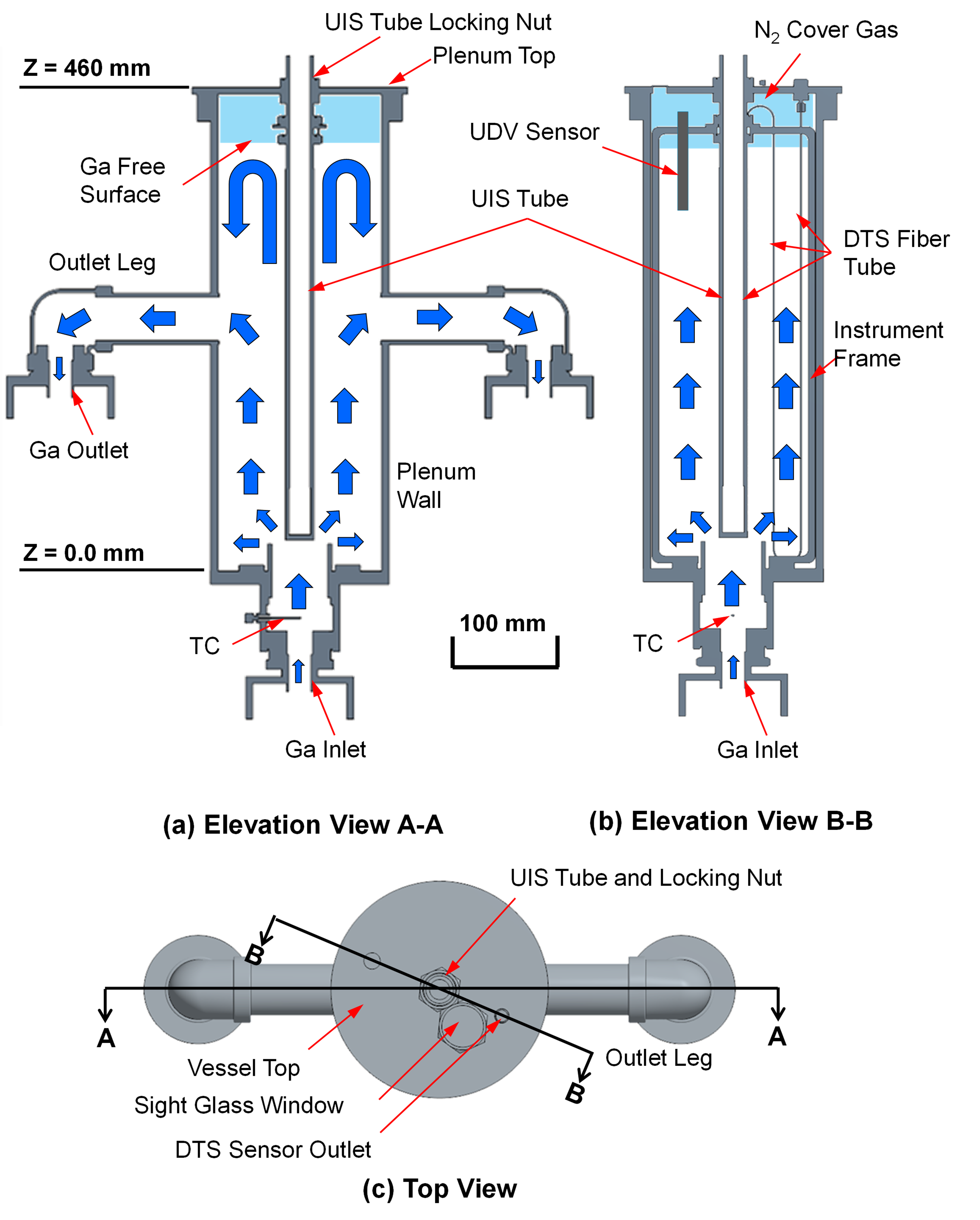
Fig. 1. Cutaway section views of the upper plenum in the GaTE facility.
The analyses of the PLOP experiments are performed using the STAR-CCM+ commercial CFD code. They investigate the formation of the liquid mixing eddies in the GaTE upper plenum and calculate the temperature and average velocity distributions in the plenum and compare the results for a rigid and a non-rigid liquid gallium free surface. The performed analyses using the LES turbulence model predict complex liquid mixing patterns which could not adequately be resolved using the URANS SST k-ω turbulence model. Results also show that the thickness of the hot liquid stratified layer near the free surface progressively decreases with increasing the injection rate of the cooler liquid gallium into the plenum and the time of simulated transients. With a non-rigid gallium free surface, extensive formation of small turbulent mixing eddies occurs in the top plenum section and the thickness of the hot liquid stratified layer decreases slightly faster with time than in the analysis with a rigid free surface.
Animation of calculated temperature field in the plenum of the simulated transient PLOP experiment with cooler gallium inlet temperature and flow rate of 323.15 K and 1.498 kg/s with rigid free surface.
Animation of calculated temperature field in the plenum of the simulated transient PLOP experiment with cooler gallium inlet temperature and flow rate of 323.15 K and 1.498 kg/s with non-rigid free surface.
Animation of the calculated temperature field in the plenum of the transient PLOP experiment with liquid Ga inlet temperature and flow rate of 323.15 K and 2.246 kg/s with rigid free surface.
Animation of the calculated temperature field in the plenum of the transient PLOP experiment with liquid Ga inlet temperature and flow rate of 323.15 K and 2.246 kg/s with non-rigid free surface.
More information of this research can be found here:
Technical Reports
Mohamed S. El-Genk, Timothy M. Schriener, Keenan Kresl-Hotz, CFD Modeling of a Simulated Protected Loss of Power in the Gallium Thermal-hydraulic Experiment (GaTE) using STAR-CCM+. Technical Report UNM-ISNPS-03-2024, Institute for Space and Nuclear Power Studies (ISNPS), University of New Mexico, (October 2024). [Download Available]
Mohamed S. El-Genk, Timothy M. Schriener, Keenan Kresl-Hotz, CFD Modeling of Liquid Mixing and Stratification during a Simulated Protected Loss of Power Transient in the Gallium Thermal-hydraulic Experiment (GaTE) using STAR-CCM+. Technical Report UNM-ISNPS-03-2024, Institute for Space and Nuclear Power Studies (ISNPS), University of New Mexico, (October 2025). [Download Available]
Refereed Journal Publications
El-Genk, M.S., T.M. Schriener, K. Kresl-Hotz, Simulation of Liquid Mixing and Stratification in Upper Plenum of Pool-Type Sodium Fast Reactors Following Sudden Decrease in Power or Scram. J. Nuclear Technology, 1-28, 2026.
Conference Extended Abstracts
Kresl-Hotz, K.R., El-Genk, M.S., Schriener, T.M., "Numerical Mesh Refinement for Flow Mixing in Pool Type SFR." Proceedings ANS Student Conference 2025, Albuquerque, NM, April 3-5, 2025.
Kresl-Hotz, K.R., El-Genk, M.S., Schriener, T.M., "CFD Analyses of the Flow Mixing and Stratification in Pool Type SFR." Proceedings ANS Student Conference 2025, Albuquerque, NM, April 3-5, 2025.
2. CFD Simulation Analyses of the Blowdown Phase of a Depressurized Loss of Forced Cooling Accident in a HTGR using STAR-CCM+
A Depressurized Loss of Forced Cooling (DLOFC) is identified as one of the postulated design-basis accidents for High Temperature Gas-cooled Reactors (HTGRs). Following an unlikely break in the primary coolant system, the circulating hot He gas coolant in the primary loop discharges into the reactor and steam generator cavities. Such an accident proceeds in three successive phases, namely: (a) the blowdown phase, (b) the refill phase, and (c) the ingress phase. During the blowdown phase, the pressurized He exits through a break into the containment cavities and displaces and mixes with the air within. As He continues to discharge from the primary system, the pressures in the connected reactor and steam generator cavities approach equilibrium. This marks the transition to the second phase of the accident, the refill phase, where air inside the containment cavities is drawn back into the cavity where the break occurred. At this stage, the He-air mixture may enter the reactor primary loop through the break(s) in the primary cooling system and flow up through the core, causing gasification of the graphite structure and the fuel elements. Air ingress can create multiple safety concerns, including: (a) oxidation of the structural graphite components in the reactor, potentially decreasing their structural integrity, (b) remobilization of radionuclides and 14C within the core graphite, and (c) potential generation of flammable gases such as carbon monoxide (CO) [Find more ISNPS research on Graphite Gasification here].
CCNY conducted experiments in the scaled Reactor Cavity Test Facility (RCTF) to investigate the mixing of injected hot He with air in the reactor and other connected cavities during a simulated DLOFC event (Fig. 2). They examined the effects of different break geometries, orientations, and locations on the mixing of the injected hot He with air in the cavities, as well as on the spatial distributions of temperature, oxygen concentration, pressure, and mixing velocities.
UNM-ISNPS is performing CFD analysis modeling He-air mixing in the cavities within the CCNY RCTF during the simulated blowdown phase of a DLOFC event. The present CFD analyses investigate the effects of the He injection rate, the initial reactor cavity temperature, and the He injection direction on the He-Air mixing, and the spatial distributions of temperature and oxygen concentration in the RCTF cavities. The performed analyses using the STAR-CCM+ commercial CFD code employ the Large Eddy Simulation (LES) and Unsteady Reynolds Averaged Navier Stokes (URANS) turbulence models.
The CCNY RCTF comprises a series of connected rectangular cavities representing those of the reactor, steam generator, the equipment shaft, and the upper and lower vent spaces (Figure 2). The facility, modeled after the GA-MHTGR design, can be configured to represent different HTGR containment designs by opening and closing the connections between the cavities. A valve isolates the reactor cavity from the steam generator cavity until the measured pressure difference between these cavities reaches 6.89 kPa. Beyond this point, the two cavities are connected. The experiments investigated the spatial and temporal distributions of the He-air mixture temperature measured by thermocouples (TC) and the oxygen concentration using high-temperature zirconia oxygen sensors (O) within these cavities during the blowdown and refill phases of simulated DLOFC events (Fig. 2).
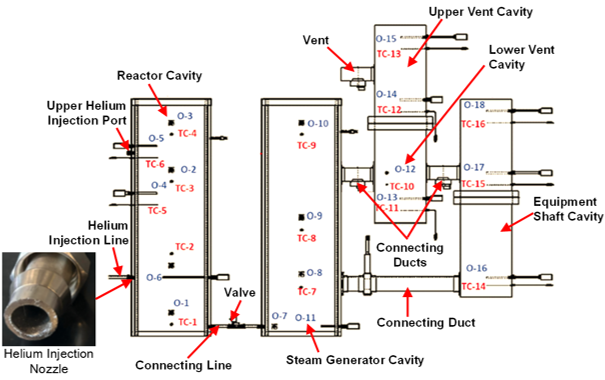
Fig. 2. CCNY RCTF He-air gas mixing facility showing arrangement of cavities and locations of thermocouples (TC) and oxygen sensors (o).
The CFD analyses of the DLOFC blowdown transient experiment by ISNPS examine flow mixing in Reactor and Steam Generator Cavities (Fig. 2) provide detailed images of the flow field and the spatial distributions of the temperature and oxygen concentration. The following animations show examples of the modeled flow mixing within Reactor and Steam Generator Cavities using the LES and URANS turbulence models.
Calculated temperature field images of He-air mixing in Reactor and Steam Generator Cavities using LES turbulence model
Calculated temperature field images of He-air mixing in Reactor and Steam Generator Cavities using URANS turbulence model
Calculated oxygen concentration field images of He-air mixing in Reactor and Steam Generator Cavities using LES turbulence model
Calculated oxygen concentration field of He-air mixing in Reactor and Steam Generator Cavities using URANS turbulence model
More information on this exciting research can be found in the following publications.
Technical Reports
Keenan Kresl-Hotz, Mohamed S. El-Genk, CFD Simulation Analyses of the Blowdown Phase of a Depressurized Loss of Forced Cooling Accident in a HTGR. Technical Report UNM-ISNPS-02-2026, Institute for Space and Nuclear Power Studies (ISNPS), University of New Mexico, (May 2026). [Download Available]